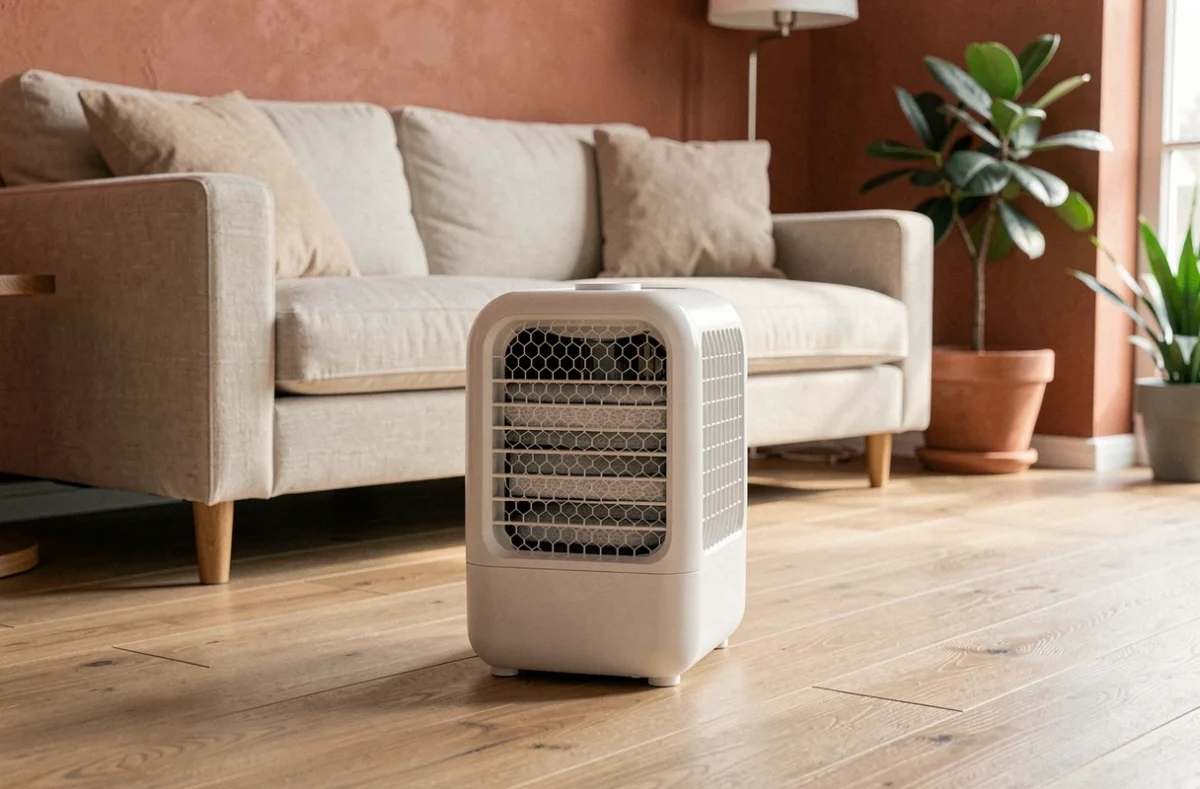
An air cooler utilizes a simple physical phenomenon: the evaporation of water absorbs thermal energy and lowers the temperature of the air passing through a wet pad. This process, called adiabatic cooling, does not use any refrigerant and does not transfer heat outside the home. Understanding this mechanism allows for a precise evaluation of what such a device can (and cannot) offer.
Adiabatic evaporation: the physical principle behind the air cooler
The cooler draws in warm ambient air and passes it through a cellulose filter kept moist by a pump connected to a water reservoir. In contact with this pad, some of the water transitions from liquid to gas. This phase change consumes energy in the form of heat, which reduces the temperature of the air blown into the room.
The result is a cooler airflow, but also one that is more humid. This trade-off conditions the entire effectiveness of the system: the blown air gains humidity what it loses in temperature.
Unlike a compression air conditioner, the cooler does not remove heat from the home. It provides localized relief in the airflow without permanently altering the overall temperature of the room. The operation of an air cooler therefore relies entirely on this ability of water to absorb heat as it evaporates.

Relative humidity: the factor that determines the effectiveness of the cooler
Most disappointments related to air coolers stem from a variable rarely highlighted on packaging: the relative humidity of the ambient air. The drier the air, the more it can absorb water vapor, and the more noticeable the cooling effect. In hot, dry climates, the perceived temperature drop can be significant.
Conversely, when the relative humidity exceeds a certain threshold, the air can hardly absorb any additional vapor. Evaporation slows down, the temperature of the blown air barely decreases, and the room becomes muggy. Under these conditions, the cooler adds discomfort instead of removing it.
Where is evaporative cooling relevant in France?
The interior southeastern regions, where summers are hot with moderate relative humidity, offer the most favorable conditions. Coastal areas or regions with high summer humidity are significantly less suitable.
Before making a purchase, checking the average humidity of your locality in summer is a basic precaution. An air cooler in a humid area cools little and humidifies a lot.
Room ventilation: the operating condition that many forget
An air cooler continuously injects water vapor into the space where it operates. Without air renewal, this humidity accumulates. The level rises, efficiency drops, and the environment becomes unpleasant, even conducive to mold.
The solution is to maintain air circulation between the inside and outside while using the device. Specifically, this means:
- A window or door slightly open, ideally opposite the cooler, to create a cross breeze that expels excess humidity.
- Sufficient space around the device so that intake and exhaust are not obstructed by furniture or a nearby wall.
- A room size appropriate for the device’s airflow: a small model in a large open space will have no measurable effect on the ambient temperature.
This ventilation requirement radically distinguishes the cooler from the air conditioner. An air conditioner operates with doors and windows closed, as it extracts heat. A cooler operates in a partially open room, which limits its use in homes facing noisy streets or exposed to outdoor pollution.
Water consumption and maintenance: the hidden costs of the air cooler
The low electricity consumption of coolers is often highlighted, and it is indeed real. A domestic unit consumes much less than a portable air conditioner. However, the overlooked expense is water.
The reservoir must be filled regularly, sometimes several times a day during high heat. With prolonged use over a summer, this water consumption becomes a factor to consider in the budget, especially in regions subject to summer water restrictions.
The wet pad requires regular maintenance
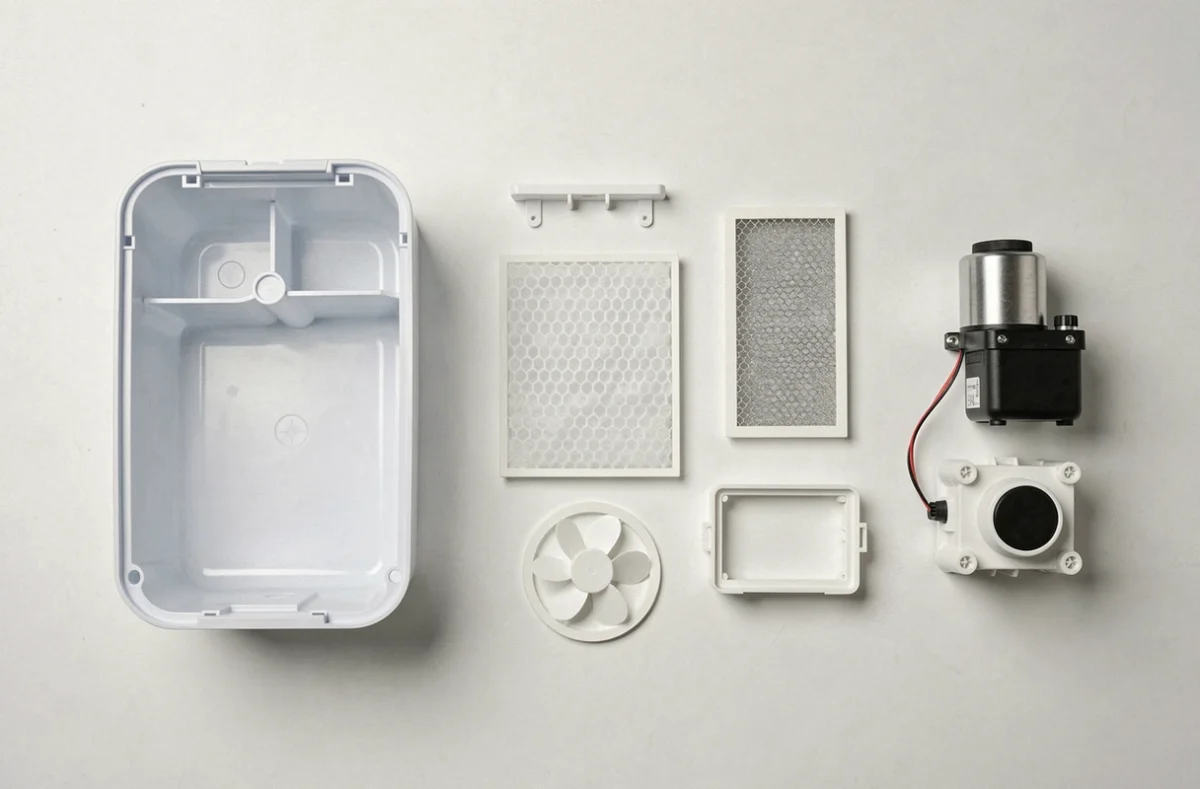
The cellulose filter that serves as the evaporation medium accumulates limescale and can become a breeding ground for bacteria if water stagnates. Manufacturers recommend frequent cleaning of the reservoir and periodic replacement of the pad.
Neglecting this maintenance degrades performance and poses a health risk. Stagnant lukewarm water in a poorly maintained reservoir can promote the proliferation of microorganisms, a point rarely addressed in consumer buying guides.
Air cooler vs air conditioner: two incomparable logics
Comparing these two devices is like comparing a fan to a refrigerator. The compression air conditioner transfers heat from the inside to the outside through a refrigerant circuit. It actually cools the room in a measurable and lasting way, with doors closed.
The cooler produces a localized flow of cool air without altering the overall thermal balance of the home. Its advantage lies in its lower purchase cost, installation without construction work, and very low energy footprint. Its limitations are structural: it does not replace an air conditioner during prolonged heatwaves.
The choice between the two depends on three concrete criteria:
- The local climate (average summer humidity).
- The ability to ventilate the room during use.
- The level of cooling expected: a few degrees of occasional comfort or stable cooling of the entire room.
An air cooler is a simple and effective device in its application domain, provided that this domain is well identified. Used in a ventilated room, in dry conditions, with regular maintenance of the reservoir and pad, it provides appreciable comfort for a fraction of the cost of air conditioning. Outside of these conditions, its performance remains marginal.